

The strait was famous for killing things. Currents collided where the Tyrrhenian met the Ionian, and the fishermen of Messina had pulled monsters out of the whirlpools for as long as anyone could remember1. It was a good place, the young German decided, to dredge.
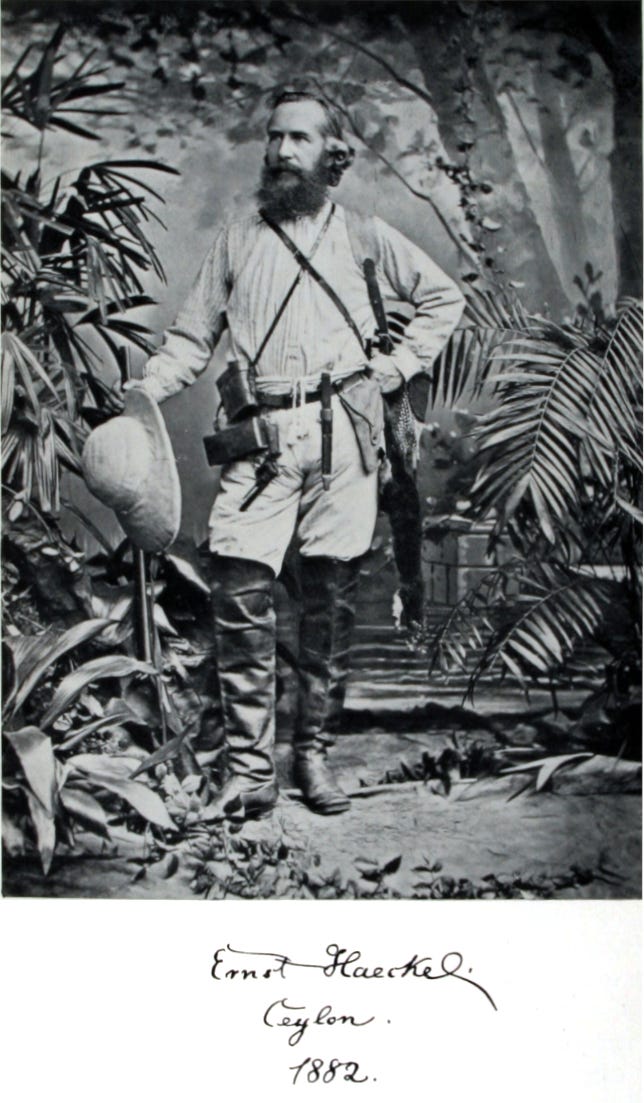
Ernst Haeckel was twenty-six years old and had no business being happy. His father had paid for a medical education and expected a practice in Berlin — respectable, salaried, sane. His mentor, Johannes Müller, the great physiologist who had first shown him the shimmer of life under a lens, had died the year before last, leaving him professionally orphaned. And Haeckel himself could not decide what he was. In Rome, the winter before, he had walked the Campagna with his easel and nearly resolved to become a landscape painter. The watercolors survive. They are good. They are not that good.
So he had made the compromise that would define his life: he would look at nature the way a painter looks, but through a microscope.
Each morning the boat went out and the tow-net came up dripping with what everyone else threw back — the transparent dregs of the sea, plankton, the marine equivalent of dust. Haeckel spread it on glass slides and bent over his lens at a wobbly table, and there, at the edge of visibility, were the radiolarians.
Single cells. Each one building, out of glass drawn from seawater, a cathedral: geodesic spheres of silica meshed in hexagons, spines radiating in perfect symmetry, lattices of a precision no hand could cut and no architect had yet dared. Skeletons of pure geometry, assembled by a droplet of living jelly with no brain, no blueprint, no engineer.
He drew them obsessively — over a hundred species no one had ever named. And somewhere in those months at the strait, watching form arise from almost nothing, the habit took hold that would make him famous and make him wrong: he read pattern out of nature, and the pattern always told him more than it should.
I. The Cell as Architect
Where does form come from?
The radiolarian skeleton poses a question biology still finds faintly embarrassing. A single-celled organism drifting in open water has no obvious use for gothic vaulting — yet here it is, silica drawn from seawater and assembled into a geodesic lattice that encloses maximum volume in minimum material, resists pressure from every direction at once, and distributes stress along its struts the way a dome does. This is not decoration, and it is not, in any simple sense, an adaptation somebody selected for. It is what you get when surface tension and crystal chemistry are allowed to negotiate without interference. The form is constrained — by the mechanics of biomineralization, by the geometry of close packing, by the budget of silicon the sea will surrender. Whether it is optimal is a claim biology has learned to make carefully; that it is necessary, given the constraints, is harder to deny.
This distinction — constrained, not designed; necessary, not optimal — is exactly the one Haeckel could see with his eyes and could not hold in his philosophy. His eyes were superb. He had trained them under two very different masters: Rudolf Virchow, the iron discipline of cellular pathology, and Johannes Müller, who could still look at a marine worm with something close to reverence — and before either of them, on the Campagna, with a brush. Haeckel drew the way a painter draws: composing, emphasizing, arranging the plate so the symmetry sang, in an era when contemporaries already noticed that his illustrations were more beautiful than his specimens. The compositional instinct — the conviction that nature’s patterns should resolve, that the picture ought to come out clean — was at Messina a virtue, in the embryo plates a scandal, and everywhere the thread that runs through what follows.
But there was a conviction underneath the instinct, and it matters to name it, because everything Haeckel ever did is an application of it. Already in the Messina monograph he was saying the thing he would never stop saying: that the same formative laws run without break from the crystal to the cell, from the cell to the organism, from the organism to the mind that contemplates it. No gaps, no jumps, no separate kingdoms of matter and life and spirit — one continuum of form. As a lens for looking at radiolarians, it is almost certainly true. His life is the record of what happens when you refuse to find the edge of it.
Because if form is legible, it is exportable. And Europe was waiting.
II. When Form Escaped the Laboratory
What happens when a microscope becomes a design studio?
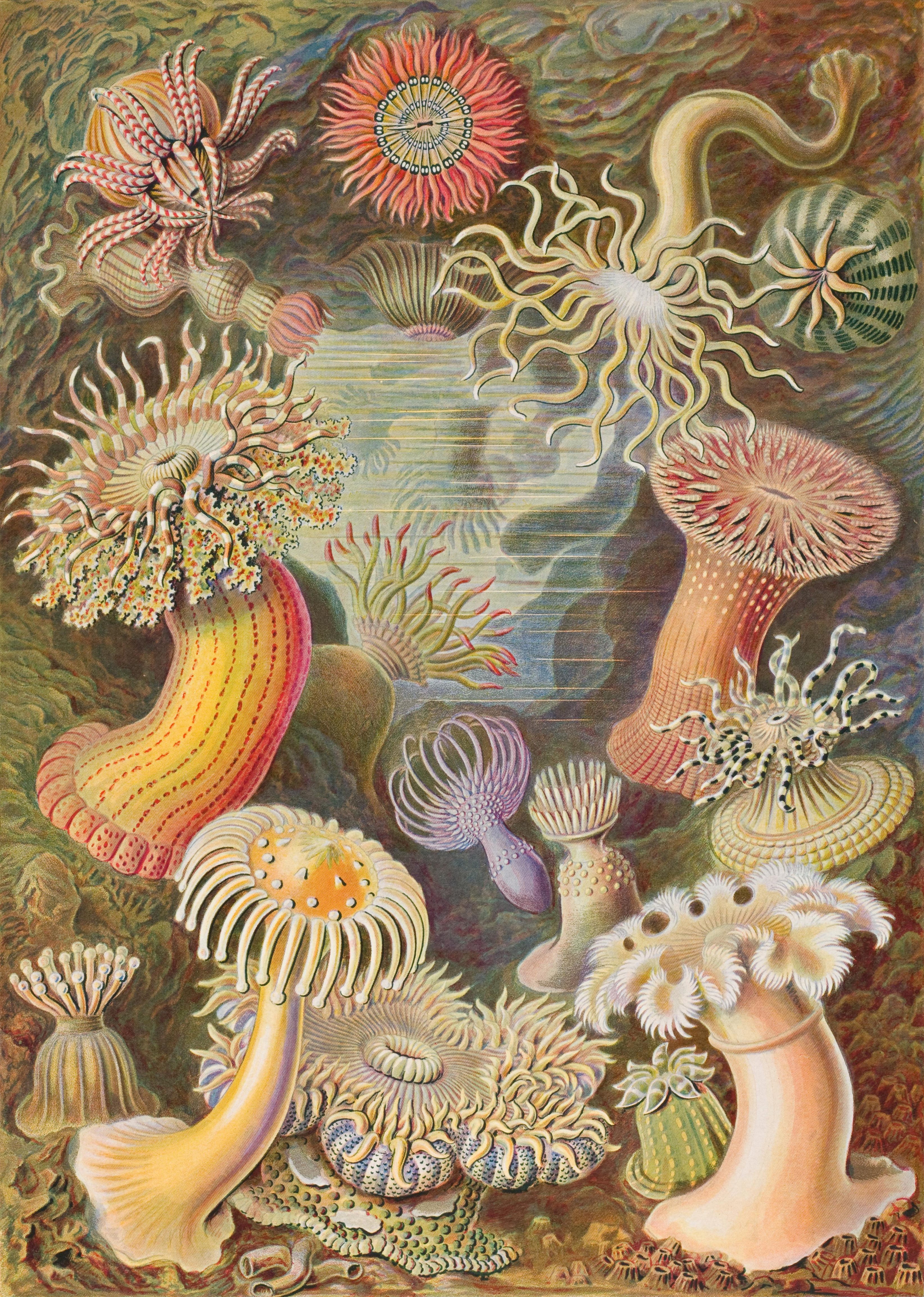
Between 1899 and 1904, Haeckel published Kunstformen der Natur — Art Forms in Nature — one hundred lithographic plates of organisms, mostly marine, mostly microscopic, rendered with a lushness no scientific monograph had ever attempted. Jellyfish cascade like chandeliers. Diatoms arrange themselves into mandalas. The radiolarians of Messina return, forty years on, as full-page baroque architecture.
The plates deserve a second byline. Adolf Giltsch, Haeckel’s lithographer, was the man who translated microscopy into print — and translation is the right word. The engraver’s burin could not render transparency or hesitation; it rendered line, contrast, rhythm. Under Giltsch’s hand, the organisms gained whiplash curves, sharp symmetries, dynamic repetition. The plates are among the great collaborations in the history of science, and they are also, quietly, a work of interpretation: nature edited for graphic force.
They detonated. To understand why, you have to remember what European decoration looked like in 1899: exhausted. A century of revivalism — Greek columns, Gothic tracery, Renaissance swags, all recycled — had left designers starved for an ornament that was genuinely new. And here, certified by the most famous scientist in Germany, was an entire unseen world of form. Not quotation from the past: revelation from the present.
Notice the leap Haeckel himself is making here, because it is his, not his readers’. Kunstformen is not a zoological atlas with unusually handsome illustrations; it is the continuity claim in aesthetic dress. The plates argue, without a word of text, that the formative laws of the silica skeleton and the formative laws of the beautiful are one — that art is nature’s geometry continuing by other means. That is monism already, hanging on a gallery wall.
The translation into matter followed with startling speed. Stand at the Porte Monumentale of the Paris Exposition of 1900 — René Binet’s great gate — and you are standing inside a radiolarian: a perforated dome of iron and glass, its apertures opening like the pores of a silica skeleton. This case is documented almost too neatly: Binet owned the plates, corresponded with Haeckel, and said what he was doing. Émile Gallé etched medusae into glass so that the jellyfish regained, in a vase, the translucency the lithograph had stolen. And then there is Gaudí, whose name is always invoked in this story and whose case is the most honest test of it2. Whether or not he ever opened Kunstformen — the paper trail is thin, and his structural vocabulary has other, better-documented sources — his branching columns in Barcelona and the skeletons of Messina solve the same problem the same way: load carried by divergence, stress answered with geometry. The parallel is real even if the lineage is not, and in a way the parallel is the deeper point. The formative laws do not care who discovers them.
[IMAGE: Kunstformen plate of radiolarians beside Binet’s Porte Monumentale; if a third image, Gaudí’s branching columns]
What matters for our story is the fate of the leap. Haeckel had exported the pattern from microscope to art, and the pattern had redrawn European taste — and it had cost nothing. Iron does not suffer when you over-interpret a diatom; a vase does not sue. The continuity claim, deployed into aesthetics, turns out to be harmless at worst and magnificent at best. The same claim had two other domains waiting. In one of them, a reckoning was coming. In the other, none.
III. False in Detail, Generative in Direction
Can a wrong idea be more useful than a right one?
The idea was already old when Haeckel gave it its famous form. In the 1810s and 1820s, the Meckel–Serres law had taught that the embryo of a higher animal climbs the scale of lower ones — an idealist doctrine, a ladder of being re-enacted in the womb. Karl Ernst von Baer killed it. His laws of development, established by 1828, showed that embryos diverge from a shared general form: the embryo of a mammal never resembles the adult of a fish, only, at most, the embryo of one. The doctrine was a buried corpse by the time Haeckel reached it — and his genuine, radical novelty was to dig it up and give it a cause. Darwin had supplied history; Haeckel bolted history onto the old ladder and proclaimed the Biogenetic Law: ontogeny recapitulates phylogeny. The developing individual retraces the adult forms of its ancestors; half a billion years of evolution, compressed into nine months of gestation.
This reframing matters for how we judge him. Haeckel was not a bold conjecturer ambushed by later data. He revived a doctrine its executioner was still alive to defend — von Baer outlived the law’s publication by a decade and spent part of it attacking Darwinism and Haeckel’s embryology in print (Über Darwins Lehre, 1873) — and he promoted it with the full force of his compositional instinct. His great contemporary antagonist, Wilhelm His, said the damaging thing plainly: embryology should describe what is there, not illustrate what phylogeny requires.
And then there are the drawings. Haeckel’s plates of vertebrate embryos — fish, salamander, chick, human, arranged in rows to show their near-identity — were embellished. He reused woodcuts, smoothed differences, nudged embryos toward the resemblance his law predicted. He was accused of forgery in his own lifetime, and the accusation has been inflated ever since by polemicists who found it too useful to check; modern historians — Robert Richards, Nick Hopwood — have shown that some of the charges were themselves exaggerated, and that embryo illustration in that era was always a negotiated art. But the core of it stands. The man who composed radiolarians composed embryos too, and embryos, unlike architecture, are evidence.
So: a revived doctrine, defended with doctored pictures, against the living objections of the man who had refuted its first incarnation. And here is the strange part — it was one of the most fruitful errors in the history of biology. Strip away the dogma, and three things of permanent value remain.
First: the embryo as archive. Before Haeckel, classification was static — Linnaeus’s cabinet, Cuvier’s types. Haeckel forced everyone to see development as historical evidence. Because the embarrassing facts do not go away: a human embryo really does grow pharyngeal arches and a post-anal tail, and its heart begins as a single linear tube that loops and septates into four chambers — structures on a trajectory no human infant will ever complete, built only to be remodeled into something else. Why? The arches are the canonical case: a shared vertebrate developmental module whose derivatives differ by lineage — gills in fish; jaw, ear ossicles, thyroid and parathyroid in us. That is the signature not of a designer working from a blank slate but of a tinkerer, a bricoleur, modifying old blueprints because it cannot afford new ones. The developmental facts remain, even now, among the most legible arguments for common descent a general reader can be given — legible in a way molecular phylogenies are not.
Second: the vocabulary of timing. A law as rigid as recapitulation is helpless before its exceptions, and nature is full of them — stages shuffled, compressed, skipped. To defend the law, Haeckel built a quarantine vocabulary: palingenesis for the true recapitulation, caenogenesis for the deceptive deviations — and, as named subdivisions of the latter, heterochrony, a displacement in developmental timing, and heterotopy, a displacement in position. The word heterochrony is his. This is the detail that rescues him from mere stubbornness: he was not stumbling past the anomalies, he was cataloguing them with a taxonomist’s precision — in order to seal them off. The quarantine outlived the law. Walter Garstang, Gavin de Beer, and eventually Stephen Jay Gould realized that Haeckel had the causality backwards: evolution does not replay itself in development; changes in developmental timing produce evolutionary novelty. And they made his quarantine term the name of their mechanism — with the irony intact that they changed its meaning to do it. For Haeckel, heterochrony was deviation measured against the recapitulatory sequence; for his successors, it was timing change as an engine in its own right. Same word, opposite concept: the man named the thing that killed him, and the name was so good that nobody could bear to change it.
Third — and this is the eerie one — the vindication of the middle. The hourglass shape of development had been proposed on morphological and regulatory grounds in the mid-1990s, by Denis Duboule and Rudolf Raff among others: very early development is wildly diverse across vertebrates (a fish egg, a bird’s yolk, a placental mammal cleave and gastrulate in utterly different ways), late development diverges just as dramatically into species-specific forms — but in the middle, embryos converge. In 2010 the prediction met the measurements: transcriptomic studies showed that at this mid-embryonic stage — the phylotypic period, when the body axis is laid down, the neural tube forms, the somites segment and the Hox genes switch on — the oldest and most conserved genes are most active. The result has been contested on method and repeatedly supported since; the hourglass remains the working model.
Here, though, precision matters more than generosity, because Haeckel’s hit was stranger than a bullseye. He did see the narrow waist — through a brass microscope, he saw the moment when all vertebrate embryos really do look alike. But his explanation for it is not the hourglass’s explanation. He thought resemblance runs deepest there because the embryo is passing through its ancestors; the hourglass says conservation runs deepest there because that stage is developmentally least perturbable — the keystone that cannot be moved without bringing the whole structure down. Same location, incompatible mechanisms. He was wrong about the law, wrong about the ends, wrong about the why. He was pointing at exactly the right structure for exactly the wrong reason — which is perhaps the purest case in the history of science of an error more useful than the truth it replaced.
There is a lesson in this about how science actually moves: not by correct ideas replacing incorrect ones, but by generative errors — ideas false in detail that aim entire generations at the right phenomenon. In development, the leap found its vindication.
The same leap had another domain. No vindication was waiting for it.
Coda: The Leap That Found No Vindication
What hardened the habit into dogma, his biographers trace to grief. In 1864, on his thirtieth birthday, Haeckel’s wife Anna died; he never recovered, and the pattern-reader became, by degrees, a lawgiver. Robert Richards, his most sympathetic modern biographer, makes this the hinge of the life; whether or not the psyche obliges us so neatly, the work after 1864 is unmistakably the work of a man who had stopped tolerating uncertainty.
The ethical leap was not a late fall from an earlier purity — it was the same leap, made in the same years as the embryological one3. The pattern he read was the one he always read. The radiolarian’s geometry had scaled to architecture; the embryo’s archive had scaled to the tree of life; and the developmental hierarchy — higher and lower, advanced and primitive, the ladder the Biogenetic Law had built into a staircase — scaled to humanity itself. Haeckel ranked human races along it and pronounced the gap between the lowest humans and the highest apes narrower than the gap between the lowest and the highest humans. He argued that nature weeds out the unfit, and that a rational state should not interfere with the weeding. By The Wonders of Life (1904) he was saying all of it as settled science. The quotes do the damage on their own; they need no prosecuting.
How much of the twentieth century is in those sentences? Here honesty requires declining the easy verdict. The direct line — Haeckel’s Monist League feeding racial hygiene, Rassenhygiene, and ultimately Nazi ideology — has its serious prosecutors, above all the historian Daniel Gasman. It also has its serious doubters, above all Richards, who points out that the Monist League was packed with pacifists and free-thinkers the Nazis would persecute and dissolve in 1933; that German Darwinism had many rival afterlives, from Ploetz’s racial hygiene to völkisch pamphleteering to an academic biology that despised Haeckel; and that a regime which looted every available authority cannot be traced to any single source. The dispute is real, and this essay does not settle it. What is not in dispute is the structure of the failure — and the structure is the one we have been tracing all along.
Because it is one commitment, three times deployed. A real pattern, genuinely seen: the geometry of the skeleton, the convergence of the embryo, the gradations of organic complexity. Then the refusal to find the pattern’s edge: the formative laws run without break, says Haeckel, from the crystal to the cell, from the cell to the mind — and from nature to morality. In art, the continuity claim costs nothing and yields the Porte Monumentale. In development, it costs a corrected textbook and yields Evo-Devo. The difference between those two and the third is not when the leaps were made — they were made together — nor how sincerely. It is that one of them had a transcriptome coming, a century later, to sort the insight from the overreach. Ethics gets no such apparatus. Biology can describe how the strong and the weak fare in a struggle for existence; it cannot tell a society what the strong owe the weak. The moment a biological hierarchy is read as a moral one, the pattern has started telling its reader more than it should — the habit of Messina, with no shore in sight.
Go back to the strait, one last time. A young man bends over a lens, watching a droplet of jelly build a glass cathedral, and he sees — correctly — that form and life are one continuum, that the same geometry runs from the cell to the building to the body. Nearly everything he made of that vision was fruitful: the museums of Art Nouveau ironwork, the embryo’s archive of deep time, the hourglass conserved in the middle of every vertebrate that has ever developed. His tragedy was never finding the edge of the insight. The hourglass was there in the embryo all along, narrowest exactly where the resemblance runs deepest. So was the limit of what form can tell us about how to live. He found the first. He never saw the second.
Disclaimer:
Written with the help of Kimi K3
The Strait of Messina was legendary among nineteenth-century zoologists as one of Europe's richest hunting grounds for bizarre pelagic fauna: its colliding currents and extreme depth — over two hundred and fifty metres within sight of shore — regularly swept deep-water creatures to the surface, which is precisely why Haeckel chose it. Long before science, the strait was Homer country; tradition placed Scylla and Charybdis, the monster and the whirlpool, in these waters. Messina's fish market, stocked with the strait's strange hauls, was a destination for naturalists from across Europe.
The Haeckel–Gaudí connection is a recurring claim with little documentary support. Gaudí's structural vocabulary — the funicular models, the hanging-chain experiments, the branching columns — develops from his own load experiments and from Viollet-le-Duc, and much of it predates Kunstformen der Natur; his arches, moreover, are catenary, not parabolic, a distinction he was explicit about. Binet, by contrast, corresponded with Haeckel, owned the plates, and said so. Gaudí is retained here as a case of convergence — the same structural problem solved the same way — not of influence.
The racial hierarchy and the claim about the gap between the lowest humans and the highest apes appear already in the Natürliche Schöpfungsgeschichte (1868) and the Anthropogenie (1874) — contemporaneous with the Biogenetic Law, not a late development from it. Die Lebenswunder (1904) restates, in the vocabulary of Monism, positions Haeckel had held for four decades.