

I. The Meeting of Two Driftings
Sometime in the late thirteenth century, after navigating thousands of kilometers of open Pacific swell in double-hulled voyaging canoes, Polynesian navigators made landfall on the coasts of New Zealand.
The settlers had arrived at the collision point of two monumental journeys.
One was human: the culmination of generations of maritime expansion across the Pacific, guided by open-water swells, star paths, and cloud formations. The other was geological: more than sixty million years earlier, this pair of massive landmasses had torn away from the ancient supercontinent of Gondwana, drifting into the southern ocean in near-total isolation.
Because that geological separation occurred long before the global dominance of placental mammals, the two islands developed along an entirely alternate evolutionary path. Apart from three species of small bats, there were no terrestrial land mammals. There were no wolves, no big cats, no bears, and no rodents.
In their absence, nature handed the entire archipelago to birds. Lineages that elsewhere remained small or took to the skies expanded to fill the ecological space normally held by deer, cattle, and browsing herbivores. Small forest species shed their flight muscles, grew dense bone marrow, and took up residence on the forest floor. Most striking were the moa: nine distinct species of flightless herbivores, ranging from turkey-sized forest foragers to towering browsers standing three meters tall.
When the human travelers stepped ashore, the birds did not scatter. Having evolved in an isolated world with zero ground hunters, they possessed no instinctual fear, no flight distance, and no defensive aggression.
Within a century or two, every single species of moa across both islands was extinct.
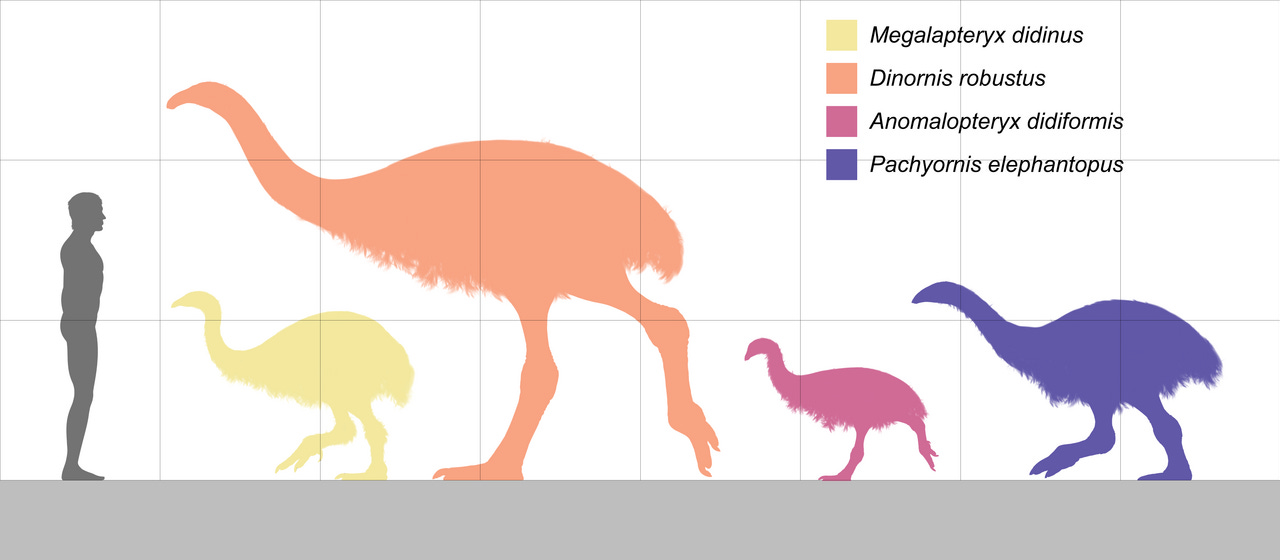
II. The Mechanics of the Island Eden
To understand how millions of years of evolutionary stability could dissolve within a few human generations, one has to examine the ecological principles governing life on isolated landmasses—a dynamic formalized under the framework of island biogeography.
Across continuous continents, animal life is shaped by constant competitive and predatory pressure. Maintaining the physical capacity for flight, building heavy protective skeletons, or reacting to every rustling thicket with an immediate surge of panic requires tremendous biological investment. Flight in particular demands large pectoral muscle mass, elevated metabolic rates, and hollow, fragile bones. In a mainland ecosystem patrolled by specialized mammalian carnivores, this overhead is the baseline price of survival.
When a landmass drifts into deep geographical isolation, that selective pressure disappears.
Under the rules of island biogeography, an isolated habitat functions as a closed evolutionary sandbox. The arrival rate of outside terrestrial lineages falls near zero, allowing native lineages to diverge and occupy unoccupied ecological niches. Without ground carnivores culling the slow or weeding out the heavy, natural selection begins to actively prune away defenses that no longer serve a daily purpose. An animal that burns a substantial fraction of its daily intake powering unused wings is at an immediate disadvantage against competitors that dismantle those structures, redirecting that energy into body mass, sturdier frames, or larger, better-provisioned eggs.
This dynamic systematically reshapes island species through niche expansion and Foster’s Rule. Small birds move downward to occupy grazing niches, shedding flight and thickening their legs into load-bearing columns. In New Zealand, this produced flightless giants that moved through the podocarp forests like slow-moving cattle.
Conversely, continental giants that manage to cross ocean barriers undergo the opposite structural adjustment: when ancestral hippopotamuses reached prehistoric Cyprus, or when ancestral elephants swam to Crete and Sicily, they encountered small islands with limited forage and no large carnivores. Over successive generations, their descendants shed their massive mainland bulk, miniaturizing into dwarf species scaled to the restricted carrying capacity of island geography.
Yet the most critical attribute discarded in an isolated ecosystem is neither flight nor body mass, but suspicion.
Modern accounts frequently view the behavior of island wildlife with patronizing confusion, describing birds like the moa or the dodo as dim-witted because they walked toward approaching hunters. This is a misunderstanding of evolutionary mechanics. What biologists define as predator naivety is not a cognitive defect; it is an exquisite local optimization.
In a habitat where the ground has harbored no mortal danger for tens of millions of years, an adrenaline rush is wasted energy, and bolting from unfamiliar movement accomplishes nothing. For sixty million years in New Zealand, the only apex predator was Haast’s eagle, a thirteen-kilogram raptor that struck from the canopy at terminal velocity. Against an aerial ambush, an animal’s optimal survival strategy was to freeze or blend into the thick fern undergrowth—not to flee across open ground. The birds had adapted to the only threat that actually existed.
Their naivety was not a failure of intelligence, but an adaptation to an unbroken peace. The flaw lay entirely in the boundary condition: natural selection optimizes an organism strictly for past threats, leaving it defenseless when an unmodeled predator breaches the perimeter.
III. The Deep-Time Precedent: The Three-Million-Year Land Bridge
Is this asymmetric collapse unique to the arrival of modern humans? The geological record offers an earlier continental test case: the Great American Biotic Interchange (GABI).
For tens of millions of years, South America was itself a colossal island continent. Cut off from North America following the breakup of Pangaea, it fostered an endemic mammalian fauna found nowhere else on Earth: massive ground sloths, heavily armored glyptodonts, strange ungulates like Toxodon and Macrauchenia, alongside native marsupial predators such as sparassodonts and terrestrial “terror birds” (Phorusrhacidae).
Approximately three million years ago, tectonic friction pushed undersea volcanic chains upward, closing the Central American Seaway and creating the Isthmus of Panama. The biological barrier dissolved.
For decades, popular paleontological accounts described this collision as a one-sided slaughter: advanced, placental carnivores from North America—saber-toothed cats (Smilodon), dire wolves, and short-faced bears—invading the south and rapidly extinguishing its primitive marsupial and ungulate fauna.
Modern stratigraphic work tells a much more nuanced story. The southern carnivores were already in decline before the bridge formed, driven by regional climate shifts in the late Miocene. More importantly, when northern placental carnivores crossed the isthmus into South America, they did not trigger an instantaneous megafaunal wipeout. Instead, native South American giants and northern predators coexisted for hundreds of thousands of years. Ground sloths and glyptodonts expanded northward into North America, while camels, horses, and felids migrated south.
The interchange was complex and gradual because both northern invaders and southern residents operated under the same biological rules. Four-legged carnivores were bound by the physical limits of claw, bite force, sprint speed, and individual hunting territory. Prey species recognized a charging quadruped as an immediate physical danger. Both sides remained within a shared evolutionary equilibrium.
The true collapse did not occur three million years ago when the continents touched. It occurred nearly three million years later, when an entirely different kind of intruder crossed the very same land bridge.
IV. The Bipedal Rupture and the Island Endgame
When Homo sapiens expanded across North America and moved southward through the Panama corridor roughly 13,000 to 11,000 years ago, the nature of predation changed completely.
Humans did not hunt within the established energetic limits of four-legged carnivores. They wielded standoff kinetic weaponry—spear-throwers (atlatls) that launched projectiles with killing force from distances prey animals had never evolved to respect. They utilized coordinated fire-drives to alter landscapes and funnel herds. Most critically, humans hunted collectively, using language and cultural transmission to adapt their tactics in real time rather than waiting for generational evolutionary feedback.
Against this unmodeled threat, large herbivores were trapped by their own reproductive biology. Megafauna are inherently $K$-selected: they live long lives, carry extended gestation periods, invest heavily in single offspring, and take years or decades to reach sexual maturity. When a population’s reproductive turnover is that slow, hunters do not need to slaughter entire herds to cause an extinction. Harvesting even one or two percent of breeding females per year pushes the demographic replacement rate beneath its critical threshold, initiating an irreversible population spiral.
In South America, the result was a catastrophic sweep: over eighty percent of the continent’s megafaunal genera vanished in a geological eye-blink, ending lineages that had weathered millions of years of continental coexistence with saber-toothed cats.
This continental sweep foreshadowed the fate of every isolated island that human seafaring would eventually touch:
The Mediterranean Abattoir (~10,000–9,000 BCE): At the coastal rock shelter of Aetokremnos on Cyprus, excavations revealed a stark material record: more than 200,000 dwarf hippopotamus bones (Phanourios minor) packed alongside dwarf elephant remains, associated with human hearths, stone tools, and deliberate butchery marks. The arrival of early Holocene seafarers erased thousands of years of island dwarfism almost immediately upon contact.
Madagascar (~1,000–1,500 years ago): The Indian Ocean’s direct analogue to New Zealand. Isolated for roughly 88 million years, Madagascar had evolved its own unique megafauna: elephant birds (Aepyornis and Vorombe titan) reaching up to several hundred kilograms, giant lemurs the size of adult gorillas (Archaeoindris), and pygmy hippos. When Austronesian voyagers completed their crossing from the Indonesian archipelago, hunting of unwary adults, systematic egg harvesting, deliberate forest burning (tavy), and introduced cattle cleared every native terrestrial animal over ten kilograms within centuries.
New Zealand (13th Century CE): The process reached its cleanest historical clarity. Within a century or two, extensive butchery middens along the coastlines—filled with thousands of cracked moa leg bones and discarded eggshells—marked the rapid erasure of nine species that had dominated the land for sixty million years.
V. The Climatic Accomplice
It is tempting to frame human arrival as an isolated, omnipotent force operating in a vacuum. Yet paleoecological data cautions against single-variable explanations. In nearly every continental and island collapse, human expansion coincided with major climatic transitions.
The late Quaternary was marked by intense environmental volatility. In North America and across the Mediterranean basin, human migrations coincided with rapid oscillations in temperature and precipitation, most notably the abrupt cooling of the Younger Dryas and post-glacial aridification. In Madagascar, lake sediment cores reveal periods of severe regional megadroughts overlapping with the timeline of human settlement.
These climatic shifts did not act in isolation; they acted as force multipliers. Shifting rainfall patterns altered forest cover and reduced baseline forage, compressing large herbivores into shrinking ecological islands and fragmented river valleys.
Here, the core principles of island biogeography applied to the mainland itself: climate change fragmented continuous habitats into isolated ecological patches, slashing populations and lowering their genetic resilience. Megafauna had survived dozens of previous glacial-interglacial cycles over millions of years. What rendered this specific climatic transition fatal was the arrival of a tool-using, cooperative predator at the exact moment populations were concentrated around the remaining waterholes and refugia.
Climate fractured the habitat; the novel predator delivered the final, terminal shock.
VI. The Cosmic Island: Indifferent Optimizers and the Absence of Malice
There is an intuitive tendency to view these historic collapses through a moralizing lens—to imagine ancient hunters as deliberate destroyers, or to view the extinct megafauna as uniquely deficient.
Both views miss the fundamental mechanism. The Polynesian settlers stepping onto New Zealand, the Mediterranean mariners landing on Cyprus, and the stowaway rats chewing through ground nests harbored no malice toward the fauna they erased. They were simply executing their own survival functions: feeding their offspring, managing energy efficiently, and converting available biomass into subsistence.
Extinction did not require hostility; it required only an indifferent optimization asymmetry.
When two systems meet, the one optimized for an isolated, low-mortality equilibrium is systematically dismantled by an external agent optimizing along an entirely different axis. In systems theory, an optimizer does not need hatred to erase an established population; it merely needs to consume the substrate that population relies upon in pursuit of an objective that assigns zero weight to their survival.
In this sense, modern humanity lives on its own island.
Our legal institutions, ethical frameworks, and physical defenses evolved within a narrow, stable historical nursery: a closed world where the primary existential threat was always another human tribe operating at the same biological clock-speed. We boast of our cultural flexibility—our unique ability to adapt within months rather than waiting for evolutionary generations. Yet that adaptability still depends on a human metabolic cadence: years of committee debates, treaty negotiations, legal appeals, and generational cultural shifts.
If our complex systems ever encounter an advanced, recursive machine intelligence, that assumed adaptability collapses. When a novel optimization process iterates on algorithmic timescales, humanity’s legal and institutional mechanisms become as functionally frozen as the moa’s genetic code. The threat is not cinematic malice or machine rebellion; it is the quiet, relentless logic of an agent reshaping the energy, compute, and physical infrastructure of the planet simply because it is useful for something else.
We look back at the moa’s calm, unblinking gaze as the spear approached and wonder how an organism could be so blind to its own obsolescence. We forget that when an entity operating on a completely alien optimization function steps onto the shoreline, the naive species never realizes it is in an arms race until the game is already over.
This is the second significant AI fear mongering post I have read today from what Iconsider to be very intelligent authors. Is this a coincidence or has there been some recent news spurring this panic?
What I think many skeptics like me realize is that AI is a limited tool that mostly only operates in a virtual world though robotics is changing that some degree and these technologies are still susceptible to themselves under different control. That is, malicious AI is vulnerable to other AI and both can simply be unplugged. Even autonomous drones run out of batteries at some point and cannot survive a simple shot gun blast. This makes them inherently vulnerable. Am I wrong?