In the fourteenth century, when Paris was a muddy market town of a hundred thousand souls, Timbuktu was one of the great intellectual capitals of the world. Its university at Sankore drew scholars from across the Islamic world. Its libraries held hundreds of thousands of manuscripts — mathematics, astronomy, medicine, law — written in languages Europe would not encounter for another two hundred years. Mansa Musa, emperor of Mali, was almost certainly the wealthiest human being who has ever lived.
This is where our story begins. Not in 2026. Not even in 1960, when the flags went up and the French left — or pretended to. It begins in the libraries of Timbuktu, because what is happening today in Burkina Faso, Mali, and Niger only makes sense if you understand the depth of what was taken, and the length of time it took to take it.
Act One: The Taking
The French arrived in West Africa in the nineteenth century with a theory: that the continent had no history worth preserving, no civilization worth inheriting, and that its resources — gold, cotton, groundnuts, uranium — existed as raw material for European industry. They built railways to the coast, not between cities. They drew borders that cut across languages, ethnicities, and ancient kingdoms. They taxed subsistence farmers in cash, forcing them into a colonial labor market they had never asked to join.
When independence came in 1960, it came with a trap built into it.
The CFA Franc — the currency still used by fourteen African nations until very recently — was pegged to the French Franc, and later the Euro, at a rate set in Paris. Member countries were required to deposit fifty percent of their foreign currency reserves in the French Treasury. In exchange, France guaranteed convertibility. It was presented as stability. It functioned as a leash. African central banks could not conduct independent monetary policy. They could not respond to local economic conditions. They held their own reserves in a foreign capital, at the pleasure of a foreign government.
Then there was the uranium.
Niger sits on some of the largest uranium deposits in the world. For decades, the French state company Areva — now rebranded as Orano — extracted it at prices negotiated under agreements that dated to the colonial era. The electricity that lights French homes, generated by French nuclear reactors running on African uranium, cost Niger a fraction of what it was worth on the open market. The Nigerien state received royalties. It did not receive sovereignty.
And when leaders emerged who asked uncomfortable questions about this arrangement, France had other tools. Thomas Sankara became president of Burkina Faso in 1983. He was thirty-three years old, a captain in the army, and he believed with the ferocity of the very young that his country could feed itself, educate its children, and break from the web of dependency that passed for development aid. He renamed the country — from Upper Volta, a colonial geographical label, to Burkina Faso: Land of Upright People. He vaccinated two and a half million children in a single week. He planted trees against the advancing desert. He refused to pay the foreign debt, on the grounds that it had been contracted by governments serving foreign interests, not the people who would repay it.
In October 1987, Thomas Sankara was assassinated. He was thirty-seven. His successor, Blaise Compaoré, reversed every reform, restored the foreign debt payments, and remained in power for twenty-seven years with French support.
The message was not subtle.
Act Two: The Cage
For the next three decades, Burkina Faso, Mali, and Niger were governed by what the French called Françafrique — a system of client relationships between Paris and African heads of state, maintained through aid, military presence, and, when necessary, more direct interventions. Elections were held. Governments changed. The underlying structure did not.
Then came the jihadist insurgencies of the 2010s. France launched Operation Barkhane in 2014 — nine years, four thousand soldiers, billions of euros — to stabilize a region it had helped destabilize over the previous half-century. The insurgencies spread anyway. By 2021, large parts of Burkina Faso and Mali were outside government control. Civilian casualties mounted. The Sahelian states watched French troops operate on their territory, asked increasingly pointed questions about what they were achieving, and began to hear different answers from different directions.
The coups came between 2020 and 2023: Mali first, then Burkina Faso, then Niger.
The Western response was immediate and predictable. “Democratic backsliding.” “Military juntas.” “Instability.” The commentary was not entirely wrong about what these governments were. It was almost completely silent about what they replaced: governments that had delivered neither security, nor development, nor dignity, for sixty years.
SIDEBAR: What is the Sahel?
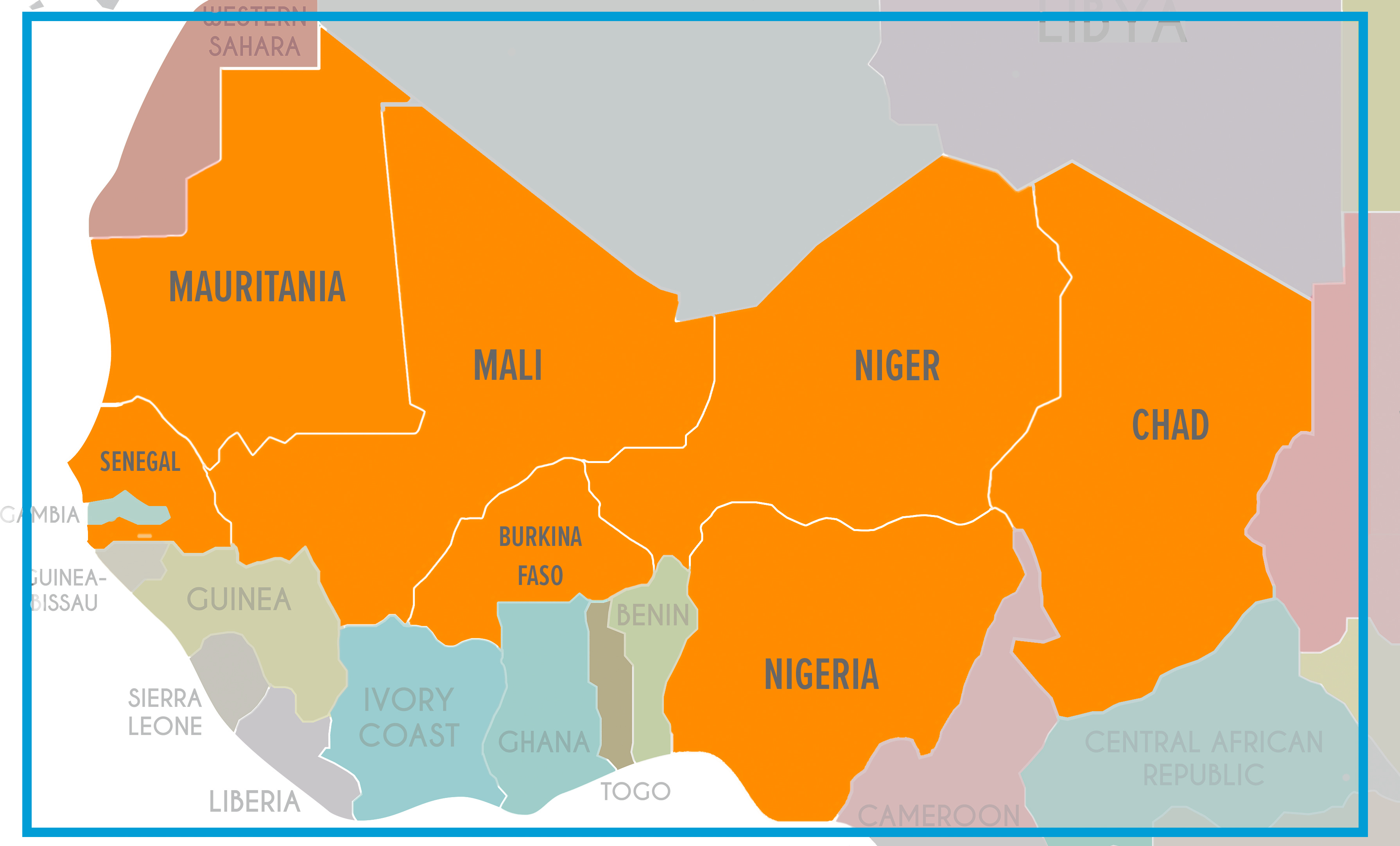
The word Sahel comes from the Arabic sāḥil — meaning “shore” or “coast.” It is the shore of the Sahara: a semi-arid belt stretching roughly 5,400 kilometers across Africa, from the Atlantic coast of Senegal in the west to the Horn of Africa in the east. It sits between the hyper-arid Sahara to the north and the wetter savannah and forest zones to the south.
The Sahel is not a political unit. It is a climatic and ecological zone — defined by rainfall between 200 and 600 millimeters per year, by a short rainy season, and by soils that reward careful farming and punish exploitation. Approximately 150 million people live across it, the majority dependent on subsistence agriculture or pastoralism.
It is also one of the regions most acutely vulnerable to climate change on earth.
This is where we arrive at the present, and where the “coup belt” narrative breaks down.
In January 2026, an alleged foreign-backed plot to remove Captain Ibrahim Traoré, Burkina Faso’s leader since 2022, was reportedly uncovered by security services. What happened next was not a military crackdown. It was something that has no real precedent in the recent history of the region: ordinary citizens flooded the roundabouts of Ouagadougou1, staying for days, to protect their government from what they understood as external interference. Not organized by the state. Not bused in. People who came because they wanted to.
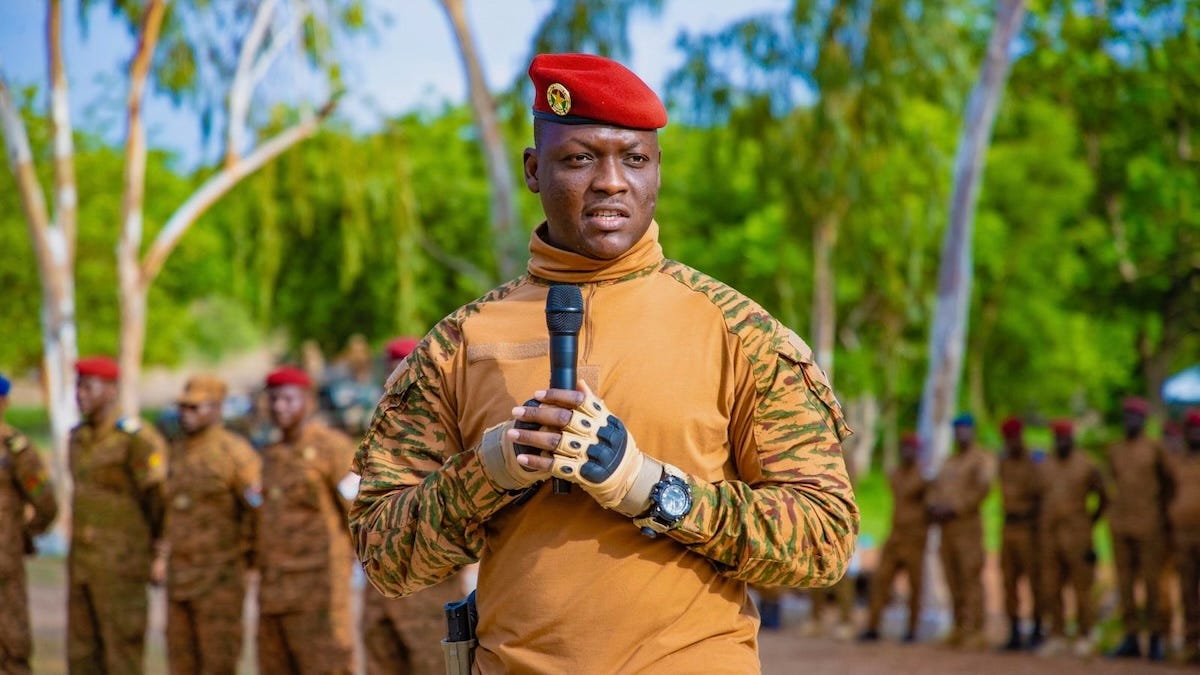
A charismatic 38-year-old, Burkina Faso's military ruler Capt Ibrahim Traoré has skilfully built the persona of a pan-Africanist leader determined to free his nation from what he regards as the clutches of Western imperialism and neo-colonialism. (copyright Ibrahim Traoré/X)
Traoré is thirty-eight years old. He is frequently described, by his supporters and his critics alike, as a Thomas Sankara avatar — which is to say, a young officer who believes in the state as an instrument of popular will rather than elite extraction, and who is aware that the precedent for what he is attempting ended with an assassin’s bullet. The comparison is not merely aesthetic. It is a statement of lineage, and of stakes.
What is he actually doing?
The 2026–2030 National Development Plan, budgeted at $64 billion, is funded not through Western aid conditioned on structural adjustment but through resource nationalism — the state demanding up to a forty-to-fifty percent stake in major gold projects. The Kiaka gold mine is one example. For decades, the model was: foreign company extracts, state receives royalties, population remains poor. Traoré is attempting to change the terms.
Despite being landlocked, despite the severing of ECOWAS ties, despite the security crisis, Burkina Faso is projected to grow at 6.1 percent in 2026 — outperforming several of its neighbors who remained within the Western orbit. These numbers will be disputed by critics. They are not being ignored by anyone watching closely.
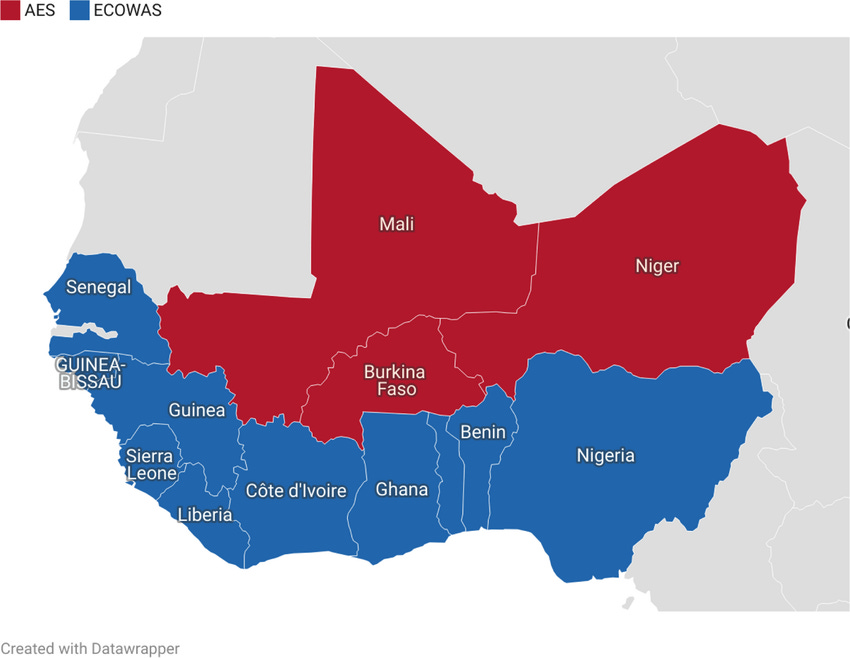
The three states — Burkina Faso, Mali, Niger — have formalized their break by creating the Alliance of Sahel States (AES), a new political and security confederation, and by exiting ECOWAS, the West African regional bloc that functioned, increasingly, as an instrument of external economic discipline.
The exit was supposed to strangle them. The AES countries are landlocked — 2.5 million square kilometers with no direct access to the sea. ECOWAS neighbors, several with close French ties, were expected to squeeze them into submission through port access and trade routes. Instead, the AES has been quietly building new corridors, refusing the siege logic, and finding that the threat was less absolute than advertised.
SIDEBAR: AES and ECOWAS — What are they?
The Alliance of Sahel States (French: Alliance des États du Sahel; AES) — comprising Burkina Faso, Mali, and Niger — was formalized in 2023 and hardened into a confederation in 2024. In 2025, the three countries formally withdrew from ECOWAS, a step widely described as irreversible. All three are landlocked, sharing borders with each other and surrounded by states that remain within the ECOWAS framework.
ECOWAS — the Economic Community of West African States — was founded in 1975 as a regional integration bloc, modeled loosely on the European Economic Community. It encompasses fifteen countries and roughly 400 million people. Its stated aims are economic integration, free movement of people, and regional stability. Critics argue it has increasingly functioned as an instrument of external economic discipline, applying pressure on member states that deviate from Western-aligned governance norms.
The New Patrons (And Why That’s Not the Whole Story)
At this point, the standard Western analysis arrives, wearing the clothes of realism: the AES has simply traded French paternalism for Russian and Chinese dependency. Meet the new boss.
It is a fair concern. It is not a complete description.
Russia’s Africa Corps — the state-directed successor to the Wagner Group — provides the security umbrella that France’s Operation Barkhane could not or would not provide. China is building the infrastructure: fiber-optic networks, the Niger-Benin pipeline, the digital architecture of a potential Digital Silk Road across the region. These are transactional relationships, not ideological ones. Moscow and Beijing are not in the Sahel to liberate anyone. They are there because there is money and influence to be had.
What the AES leaders understand — and what their populations seem to understand — is that transactional is not the same as colonial. The terms matter. The AES has replaced the CFA Franc with its own Confederal Investment Bank. It is negotiating from a position of at least nominal sovereignty. Whether that sovereignty proves durable is an open question. That it represents a structural change from the previous arrangement is not.
There is also a stranger, darker layer to the current situation. Credible reports suggest that Ukrainian military intelligence — the GUR — is operating in the desert, reportedly providing drones and tactical support to various insurgent and rebel groups, including Tuareg factions. The logic, if the reports are accurate, is grimly rational: if Russian assets are bleeding in the Sahara, they are not reinforcing positions in eastern Ukraine. The Sahel has become, by this account, a second front in a European war — with African civilians absorbing the costs of a conflict they did not choose.
SIDEBAR: The Ukraine-Sahara connection
One of the more unsettling developments of 2025–2026 is the reported extension of the Russia-Ukraine conflict into the Sahel. According to multiple regional and international sources — none yet definitively confirmed — Ukrainian military intelligence (the GUR) has been providing tactical support, including drone technology and training, to Tuareg rebel groups and other insurgent factions operating against AES governments.
The strategic logic, if accurate, is straightforward: Russian Africa Corps assets deployed in Burkina Faso, Mali, and Niger represent resources not available on the European front. Bleeding them in the Sahara serves Kyiv’s war aims at low direct cost.
For the people of the Sahel, the calculus looks different. A conflict born in Eastern Europe is being fought, at least in part, in their desert — by proxies pursuing interests entirely their own.
SIDEBAR: The ecology of crisis
The Sahel’s security crisis cannot be separated from its environmental one. Lake Chad — once one of Africa’s largest freshwater bodies, shared by Chad, Niger, Nigeria, and Cameroon — has shrunk by approximately 90 percent since 1960, due to a combination of reduced rainfall, rising temperatures, and agricultural overuse. Communities that depended on it for fishing, irrigation, and water have been displaced by the millions.
Across the wider Sahel, the competition between nomadic herders — largely Fulani and Tuareg — and sedentary farmers over shrinking water and land is a documented driver of the violence that the region’s security crisis is often reduced to. The jihadist insurgencies did not create this competition. They exploited it.
The Sahara is advancing southward at a rate of roughly 48 kilometers per year in some areas. The land itself is a political actor.
What the Desert Knows
Here is what the Western commentary keeps getting wrong: it frames the AES experiment as a question about democracy. Are these governments legitimate? Are they moving toward elections? Are they respecting human rights norms?
These are not unimportant questions. But they are not the questions the people in the streets of Ouagadougou are asking. They are asking a different question, one that has been deferred for sixty years: Does the state belong to us?
Performance legitimacy is not a substitute for democratic legitimacy. But it is not nothing, either. A government that vaccinates children, builds roads, insists on a larger share of its own mineral wealth, and is perceived to be doing so in the interest of its own population rather than foreign stakeholders has a claim on popular support that cannot simply be dismissed as manipulation.
The Sahel is not drifting. It is sailing away, deliberately, with charts it drew itself.
Coda: What the Dogon Knew
Far to the south of Timbuktu, in the cliff country of central Mali, the Dogon have their own cosmology — their cosmological system describes a universe with visible stars and invisible ones, a world with a face that can be seen and a face that cannot.
The West looks at the Sahel and sees the face it expects: instability, coups, democratic failure, Russian influence. It is looking at the visible star.
The hidden star is something older and more patient: a civilization that was here before the French arrived, that survived a century of extraction, and that is now — with all the messiness and danger and moral ambiguity that entails — attempting to reclaim the right to determine its own future.
The desert is long. The manuscripts of Timbuktu are still being catalogued. The story is not over.
Ouagadougou is the French transcription of Wagadugu — "where people get honour and respect" in Mooré, the primary language of Burkina Faso, spoken by over half the Burkinabé population as a first or second language across eight countries. The colonial borders never quite contained it.